Published August 11, 2026
Why the Triad Doesn’t Have Just One Real Estate Market

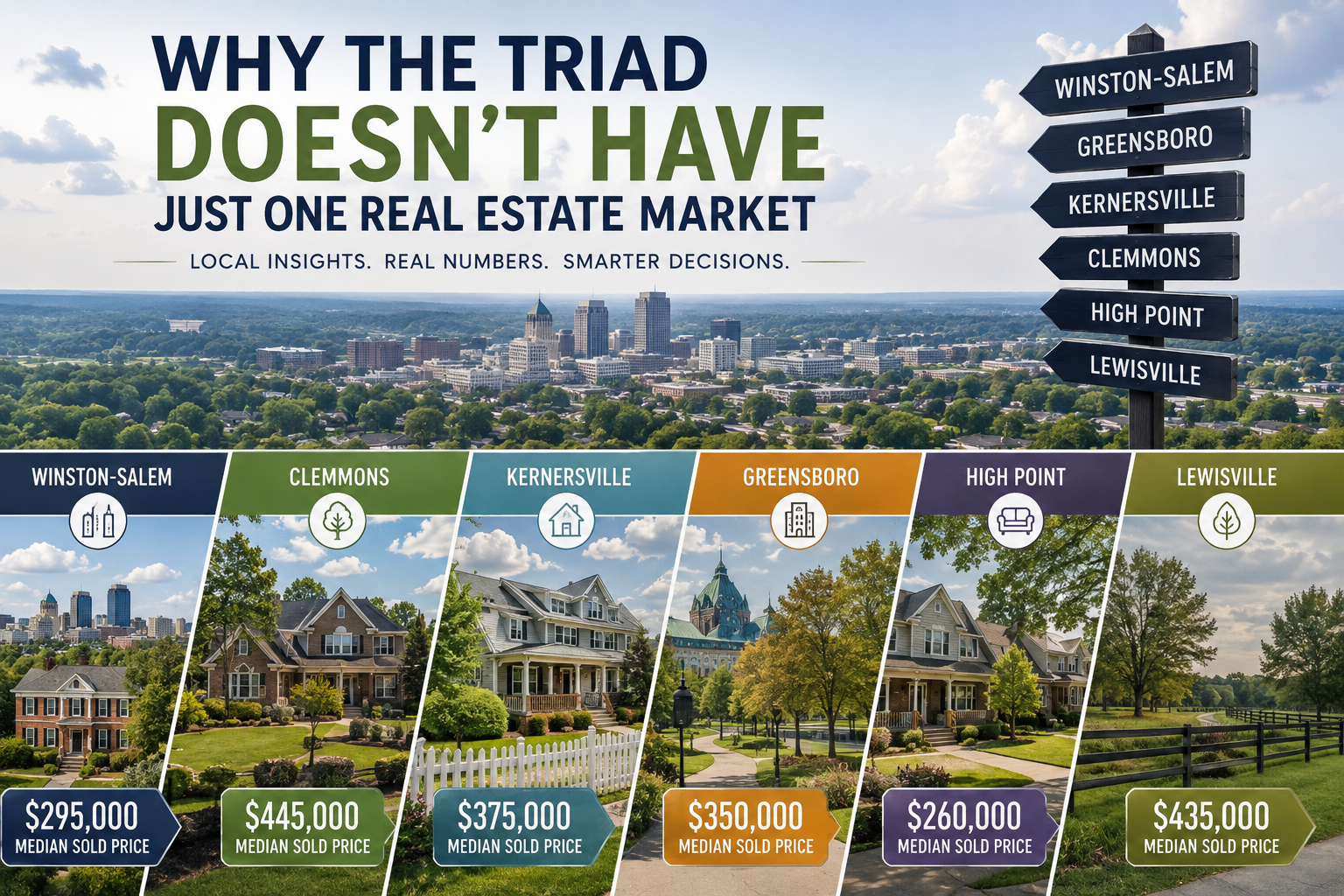
If you’ve been following real estate news lately, you’ve probably seen headlines about “the Triad housing market.”
But there’s an important detail those headlines can miss:
There isn’t really one Triad real estate market.
Winston-Salem, Greensboro, High Point, Kernersville, Clemmons, Lewisville, Advance, and the surrounding communities can all experience different levels of demand, pricing, inventory, and competition.
That’s one of the most important things to understand if you’re thinking about buying or selling a home in the Piedmont Triad.
A Home’s Location Can Change the Market Completely
Two homes can be less than 20 minutes apart and still have very different real estate dynamics.
One neighborhood might have buyers competing for well-maintained homes, while another nearby area may have more inventory and give buyers additional room to negotiate.
That’s because buyers aren't simply choosing a house.
They’re choosing a combination of:
- Location
- Commute
- Schools
- Neighborhood
- Lot size
- Home style
- Amenities
- Price
- Future resale potential
As a result, looking only at a citywide median price doesn't always tell you what your particular home—or the home you're considering buying—is worth.
What the Current Triad Market Tells Us
Recent 2026 market data illustrates just how much prices can vary throughout the region.
For example, July market data for Winston-Salem showed a median sold price of approximately $295,000, with homes averaging about 45 days on the market.
Across the broader Triad MLS area, recent data shows the regional median sold price around $362,000, with substantial differences between individual communities.
That difference matters.
A buyer who says, “The Triad median home price is around $X, so that's what I should expect to pay,” may be missing the bigger picture.
The same is true for sellers.
Your home's value isn't determined by the average price of every house in the Triad. It's determined much more by what comparable homes in your specific area are actually selling for.
Why Neighborhood-Level Data Matters
Imagine you're selling a home in Winston-Salem.
Looking at the overall Winston-Salem market can give you useful context, but it isn't enough to determine the best asking price.
A home in one part of the city may attract multiple interested buyers relatively quickly, while another property could sit for weeks or months.
Why?
Because buyers compare your property with other homes they can realistically purchase.
If three similar homes are available nearby, buyers have options.
If yours is one of only a few homes that checks all of their boxes, you may have considerably more leverage.
That's why experienced real estate professionals don't stop at citywide statistics.
They look at the micro-market.
What Is a Micro-Market?
A micro-market is essentially a smaller section of the overall housing market.
It could be:
- A particular neighborhood
- A subdivision
- A school district
- A ZIP code
- A specific price range
- A particular type of property
For example, the market for $250,000 starter homes can behave very differently from the market for $600,000 luxury homes—even within the same city.
Likewise, buyers looking for new construction may have completely different options from buyers searching for older homes with large lots.
This is why a single statistic rarely tells the entire story.
Buyers: Don't Assume Every Seller Has the Same Leverage
One of the biggest mistakes buyers can make is assuming that every home in the Triad should be approached the same way.
Some properties may have been sitting on the market long enough that a seller is more open to negotiations.
Others may be priced correctly and attract strong interest almost immediately.
National housing headlines can't tell you which situation applies to the specific home you're considering.
Instead, buyers should look at questions such as:
How long has this home been on the market?
Have there been price reductions?
What have similar homes actually sold for?
How many comparable homes are currently available?
Is the property in a particularly competitive neighborhood or price range?
Those answers can help you determine how aggressively—or cautiously—you should approach an offer.
Sellers: Your Neighborhood Matters More Than the Headlines
Sellers face the opposite challenge.
It can be tempting to see a headline about rising home prices and assume your home should automatically command a higher price.
But buyers don't make offers based on national or regional headlines.
They compare your home against the alternatives available to them.
If comparable properties are selling quickly, that can be a positive sign.
If similar homes are sitting on the market and receiving price reductions, that's important information too.
The goal isn't simply to put the highest possible number on your listing.
The goal is to find the price that positions your property competitively based on today's local market.
The Triad's Variety Is Actually a Strength
The fact that the Triad doesn't operate as one uniform housing market is actually one of the region's advantages.
Buyers have choices.
Someone who finds Winston-Salem too expensive in a particular neighborhood may discover better options in another part of the Triad.
A buyer who wants a suburban setting may consider communities such as Clemmons or Lewisville.
Someone looking for a different combination of price, commute, lot size, and amenities may find that Kernersville, Greensboro, High Point, or one of the surrounding communities fits their needs better.
The key is understanding what each area offers—and how its housing market is behaving.
Don't Let One Number Make Your Real Estate Decision
Real estate is local.
And in a region as diverse as the Piedmont Triad, it's hyper-local.
The median sale price for the entire region can be useful for understanding the big picture, but it shouldn't be the only number you consider when buying or selling a home.
The most useful information is often found much closer to home:
What are comparable properties selling for?
How quickly are they selling?
How much competition is available?
What are buyers responding to?
What is happening in your particular neighborhood and price range?
Those are the questions that can turn general market information into a strategy.
The Bottom Line
If you're considering buying or selling in the Triad, don't let a headline about the “Triad housing market” make the decision for you.
There are dozens of smaller markets within the larger region, and the conditions can vary significantly from one community to another.
The more specifically you understand your local market, the better prepared you'll be to make a smart real estate decision.
Thinking about buying or selling in Winston-Salem or the surrounding Triad area? Contact Terri Bias & Associates for a personalized look at what's happening in your specific market.